
Of floods and floating islands
if you like eating cream with a spoon, this one's for you

Everywhere there was water; not sea or rivers or lakes, but just senseless flood water with the rain splashing into it… When they came near the bridge that crossed the river, the road disappeared under water altogether and they seemed to drive into the side of the river with a great splash that flew up against the windows; but it was only a few inches deep and then they reached the humpback bridge and went up and over it, and down again into deeper water on the other side. This time they drove very carefully like bathers walking into out into cold water.
The Children of Green Knowe, Lucy M. Boston
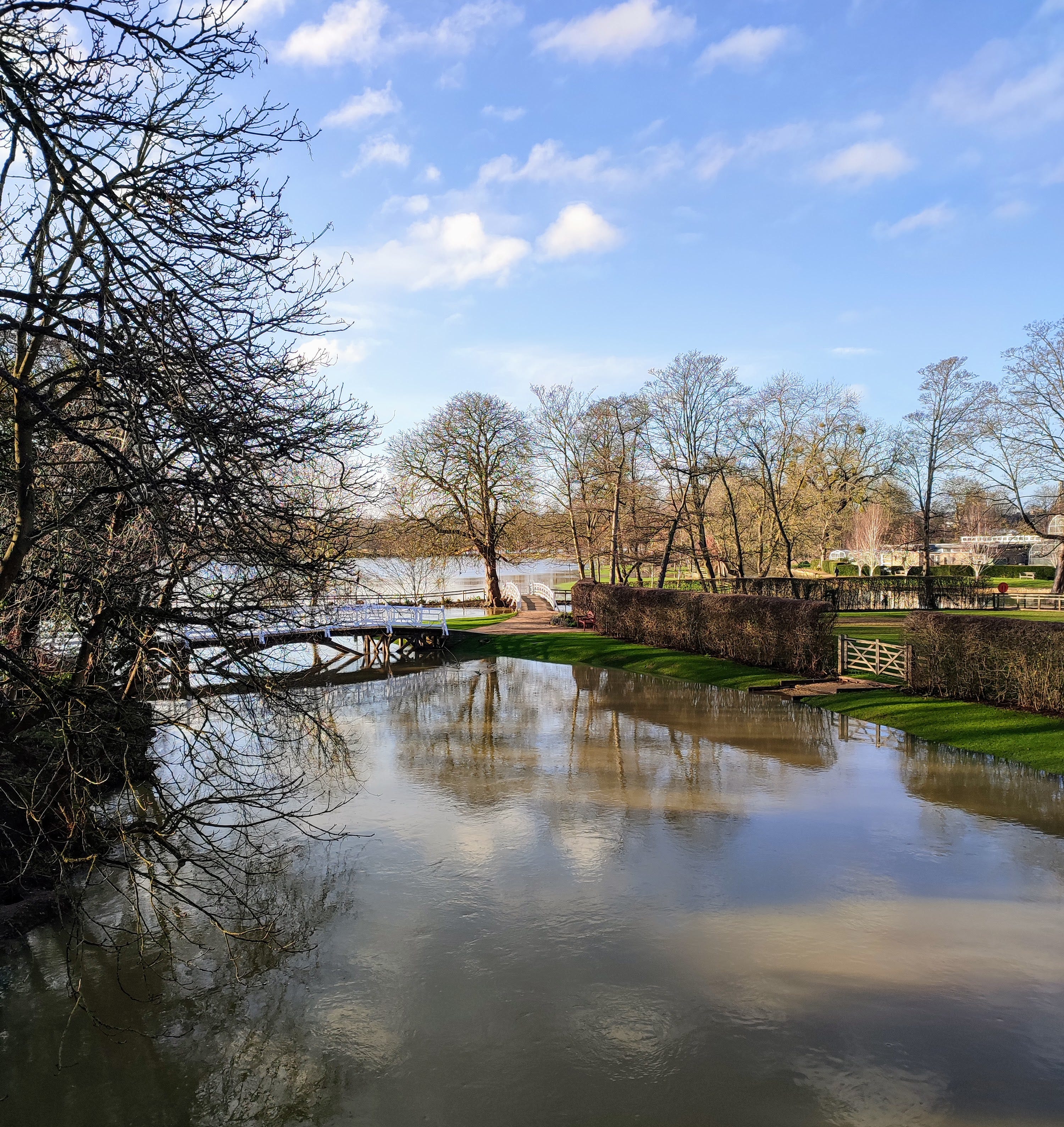
My friends and I sometimes talk about what we will do when The Great Floods Come. In this shared vision of a dystopian future, sea levels have risen and most of the country is under water. What do we do?
Obviously, the answer is to annex a small Scottish island and form a survivalist community led by a charismatic but sinister guru - after which, the arguments begin about who will be most useful in this new society. It may be a trivial game but still, driving around Oxfordshire and Gloucestershire this winter, it felt like it might be time to start scouring Scottish property websites and brushing up on farming techniques. There was something magical about the way the scrubby, muddy grasslands of late winter were replaced by shimmering sheets of water, turning ordinary views into something strange and unexpected; the rivers creeping beyond their banks as if looking for something, and Port Meadow transforming into a Venetian lagoon, with flocks of seabirds drifting through reflected skies. Although I know the damage the floods can cause, I am always a little sad when the light-filled waters drain away and the familiar land returns.
Malcolm had to peer closely at the ground, so thickly was the rain falling, and he felt against his boots a current of water running strongly away from the river. Was it overflowing its banks? He couldn’t see, but it must be… They stumbled forward over the steps that led to the terrace of the Trout, and found they had to go back - the river was racing over the terrace at the height of a tabletop: it would sweep them off their feet and away in a moment…
They could only go one way. La Belle Sauvage sped like a dart over the mad river, down towards Port Meadow, towards the wild waste of water that was sweeping through Oxford, towards whatever lay beyond.
The Book of Dust - La Belle Sauvage, Philip Pullman


With all this water on the brain, I was wondering what appropriately flood-related meal I could make, and my attention was caught by a recipe for floating islands. The modern floating island, or île flottante if you want to get all fancy and French about it, usually consists of poached meringue on a lake of creme anglaise, but recipes in the past were a lot more varied. Hannah Glasse’s ‘Flooting islands’ [sic] are more like a trifle, with layers of brioche and jellies and froth1 on top, and Elizabeth Raffald goes all out, offering recipes for a Desert Island and a Rocky Island as well as two of the floating sort, one of which involves coating a turnip with comfits (small hard sweets), setting it in a sea of jelly and decorating with ‘snakes; or any wild animals of the same sort.’
Not having any decorative snakes to hand, I decided instead to try a recipe from Maria Rundell’s catchily-titled A New System of Domestic Cookery; Formed Upon Principles of Economy: and Adapted to the Use of Private Families (1806). Even within her own recipe, there are variations suggested, as you will see below; I decided to go for the islands from ‘Another way’ with the cream from the first recipe.
Floating Island.
Mix three half-pints of thin cream with a quarter of a pint of raisin wine, a little lemon-juice, orange-flower water and sugar: put into a dish for the middle of the table, and put on the cream a froth, as will be directed in page 278 [see below], which may be made of raspberry or currant-jelly.
Another way.
Scald a codlin before it be ripe, or any sharp apple; pulp it through a sieve. Beat the whites of two eggs with sugar, and a spoonful of orange-flower water; mix in by degrees the pulp, and beat all together until you have a large quantity of froth; serve it on a raspberry cream; or you may colour the froth with beet-root, raspberry, or currant jelly, and set it on a white cream, having given it the flavour of lemon, sugar, and wine, as above; or put the froth on a custard.
….
A Froth to set on Cream, Custard, or Trifle, which looks and eats well.
Sweeten half a pound of the pulp of damsons, or any other sort of scalded fruit, put to it the whites of four eggs beaten, and beat the pulp with them until it will stand as high as you choose; and being put on the cream, &c. with a spoon, it will take any form: it should be rough, to imitate a rock.
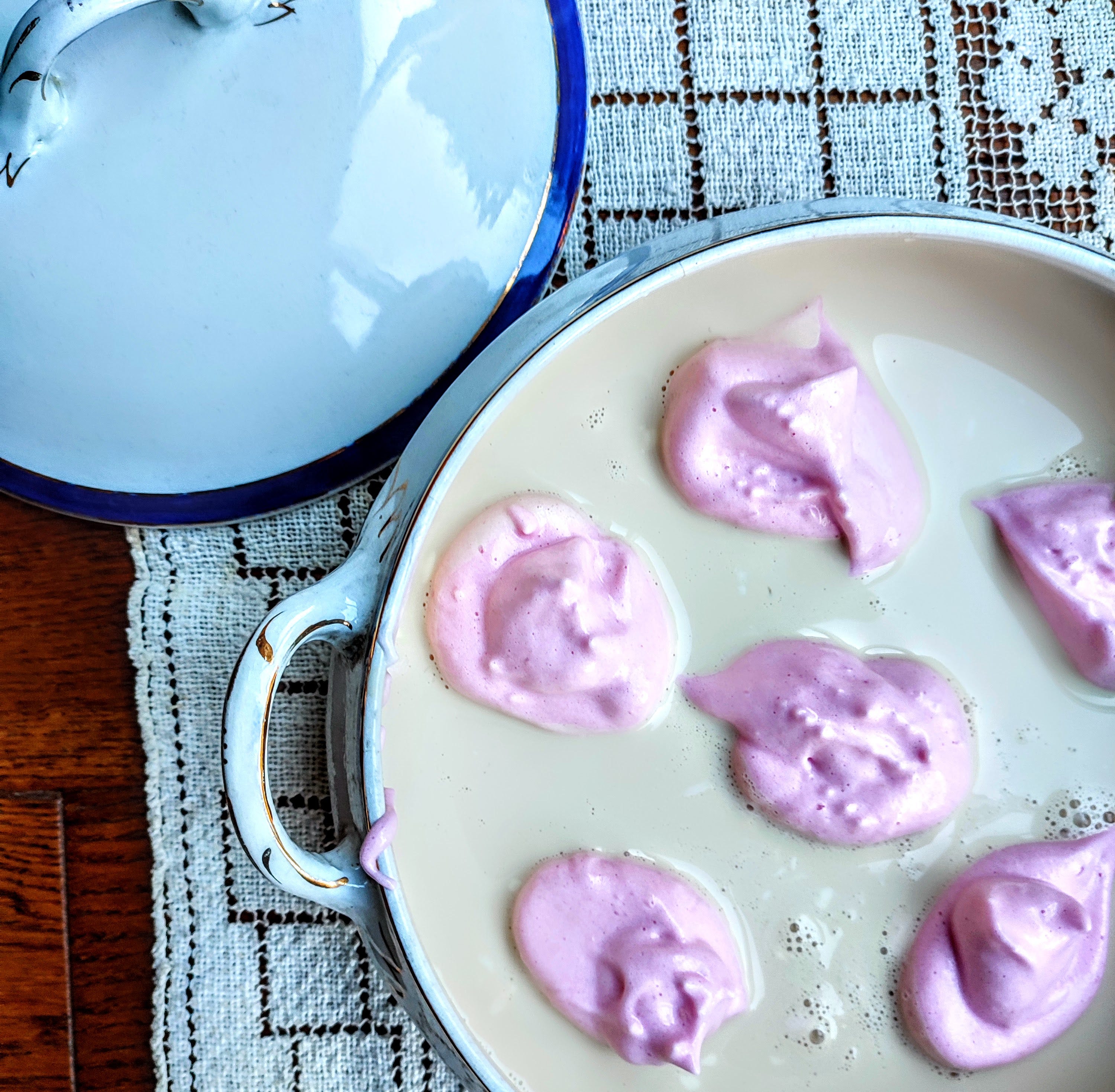
I will say right now that this was a triumph and I probably ate more of it than I should have. Luxury is a word that doesn’t mean much these days - it’s tiresome how often it’s used to describe everything from chocolate bars to bubble bath - but there really is something exquisite about this pudding. The contrast between the richly-flavoured cream and the light sourness of the froth is unlike any other dessert I can think of.
Floating Islands
For the cream
660ml single cream
100ml raisin wine or sweet sherry
2 tbsp white caster sugar
1 tbsp orange flower water
Juice of half a lemon
For the islands
2 egg whites
4 tbsp white caster sugar
1 cooking apple, peeled, cored and chopped
1 tbsp orange flower water
a few drops of pink food colouring
Put the apple in a saucepan with couple of tablespoons of water, put a lid on, and gently cook on a very low heat. Keep stirring so it doesn’t stick to the bottom of the saucepan - you want it to colour as little as possible. Bramleys are good here because of their sharp flavour, and the way they explode into a pillowy puree when cooked. You could use eating apples if you don’t have anything else, but the texture won’t be quite the same.
When the apples are cooked - they should be soft, and collapsed into themselves - give them a quick blast with a stick blender until they are velvety smooth in consistency, and leave to one side to cool.
To make your lake for the islands to float on, mix the single cream with the wine, sugar, lemon juice and orange flower water, and stir until everything is well mixed and the sugar has dissolved. You can taste it at this point and adjust the flavourings if necessary.
No longer than 30 minutes before serving, whip the egg whites, adding the sugar a little at a time, until it forms stiff peaks.
Now fold in the apple puree gently, a spoonful at a time - I used about 5 tbsp in total and that was enough to provide a good flavour.
If you want pink islands, you can now stir in some food colouring, adding a few drops at a time so you don’t end up with fluorescent foam (unless that’s what you’re aiming for!)
Pour the cream into your serving dish or tureen, and carefully dollop the foam on top to form islands. A nice alternative would be to do single servings in a small glass, almost like a minature trifle.
These evanescent little pillows of froth are best prepared right before eating as they will start to flatten and spread out if left to sit for too long. The cream however can be flavoured and prepared in advance. Any leftover cream would be delicious poured over a slice of plain cake. Or - and this is possibly a crazy idea, but one I’m dying to try - you could use it in place of milk to make a very decadent coffee?
This doesn’t look like it makes a lot, but it’s so rich you only need a small portion. I think it would serve at least 6 as a dessert, if you’re not too greedy.
Titbits
Dispatches from my kitchen
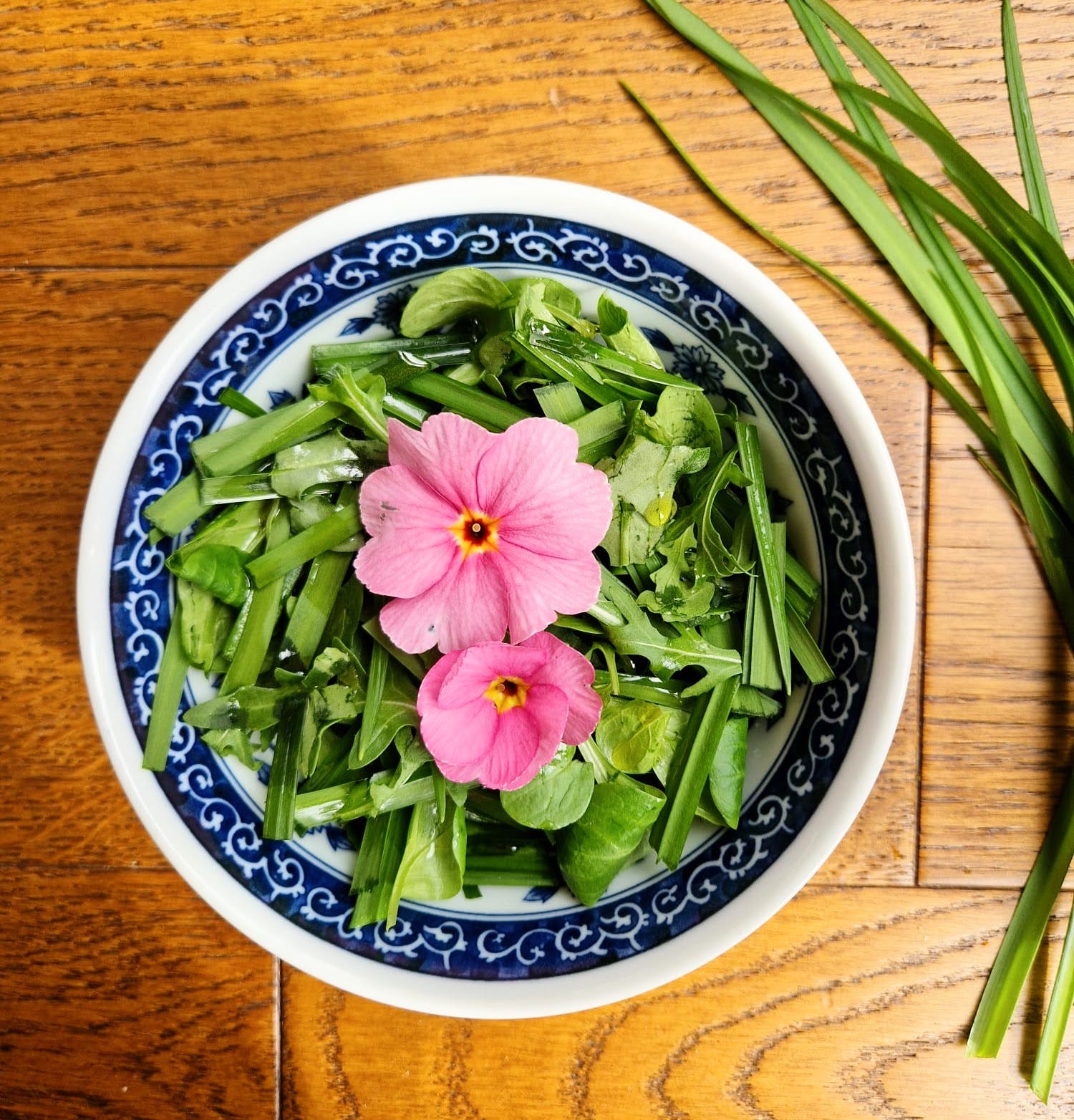
I made an early spring salad for lunch this week featuring flowers and foraged ramsons (also known as three cornered leeks) - can you guess which is the ingredient dating back to the Middle Ages, and which the trendy new addition?
Perhaps surprisingly, the ramsons are a relative newcomer to our shores. Native to the Mediterranean region, they were first brought over to the UK in the 18th century. They are now considered an invasive species, and it’s illegal to grow or cultivate them in the wild as they are very aggressive and will crowd out other native plants. This does mean that you can forage them guilt-free, and they’re worth it for their pleasant, pungent, flavour (like wild garlic but not as strong) which makes them ideal for salads or stir-fries.
Edible flowers, on the other hand, have been included in salads since medieval times, especially sweet violets and primroses (though the latter would have probably been the traditional yellow colour rather than this pink variety!) These days the flowers are often candied and used as decorations, but they can also be eaten raw or steeped to make a syrup or cordial.
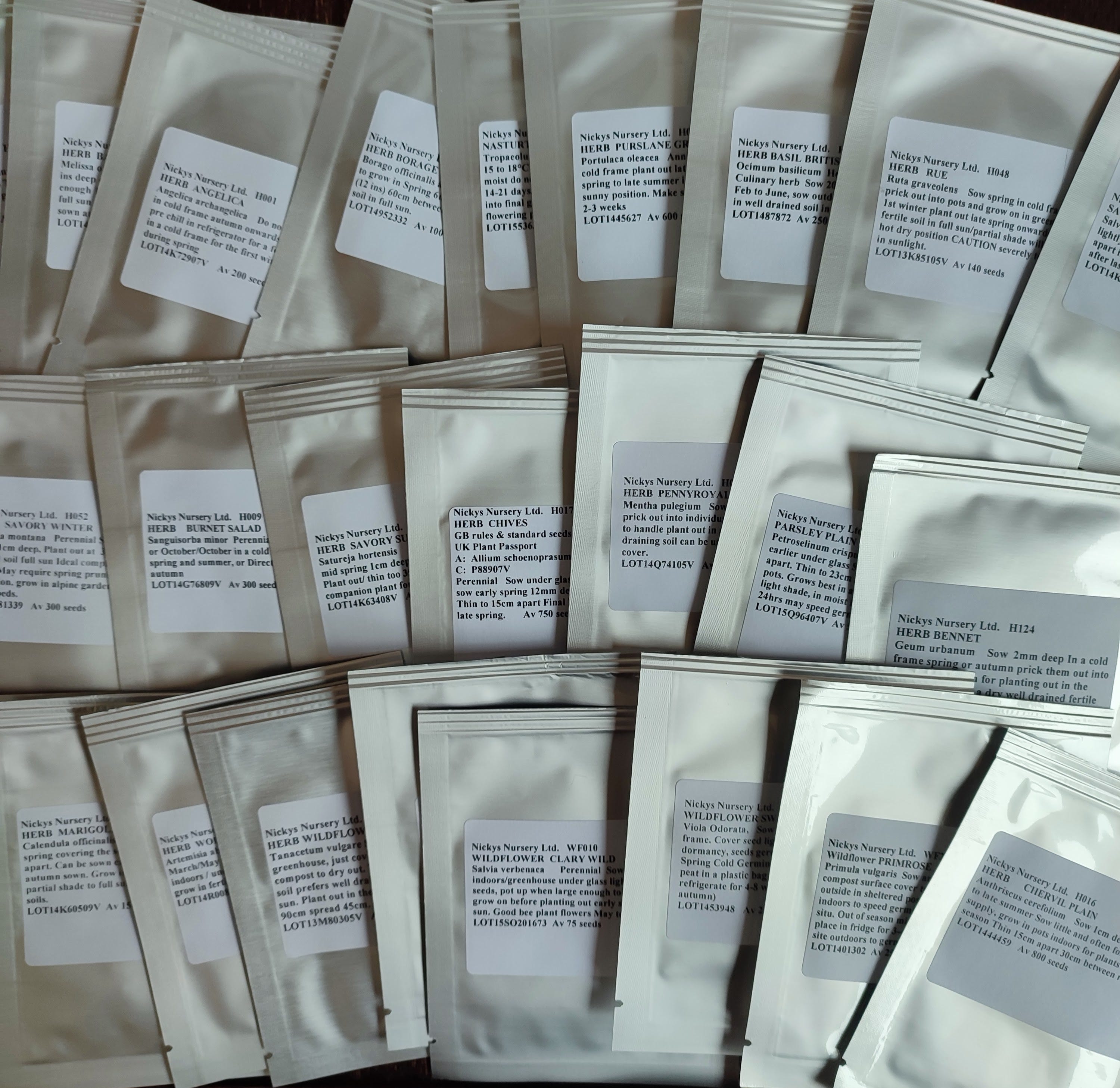
I’m getting ready to plant the first seeds for my historic herb garden - whilst many traditional herbs like sage and parsley are still very much in use in modern cooking, some - like savory, pennyroyal and hyssop - are rather more difficult to get your hands on. In the case of some herbs, which seem to cross the line between culinary and medicinal, this may be because they are actually toxic to humans - of which more in future! With luck I’ll be able to try out some medieval salad recipes this summer.
Froths and foams may seem like a very nouvelle cuisine way of cooking, but they were very popular for topping desserts or syllabubs in the 18th century - perhaps surprising when you consider that before modern whisks, whipping egg whites to stiff peaks could take an hour.
Perhaps a random place for me to and this, but have you ever made any Roman recipes ?
Bring on the Scottish isle! You can be the cook - as well as bringing your many other talents